All Notes

Funguria-Introduction, Common fungi, Clinical Feature, Lab Diagnosis, Treatment, and Prevention

Introduction

Funguria refers to the presence of fungi in the urine, either due to colonization, contamination, or true urinary tract infection (UTI).

Fig. Urine sample for fungal culture and KOH mount

It is increasingly reported in hospitalized or catheterized patients, particularly those with immunosuppression, antibiotic overuse, or diabetes. Most cases are asymptomatic, but it can lead to pyelonephritis, fungal balls, or sepsis, especially in neonates and ICU patients.

Common Fungi Causing Funguria

Fungal PathogenNotes
Candida albicansMost common; forms pseudohyphae
Candida glabrataSecond most common; less susceptible to azoles
Candida tropicalisAssociated with hematologic malignancy
Candida kruseiIntrinsically resistant to fluconazole
Candida parapsilosisCatheter-associated funguria
Cryptococcus neoformansRare; may be seen in AIDS or renal transplant
Aspergillus spp.Very rare; usually from contamination or systemic spread

Clinical Features

  • Most patients are asymptomatic.
  • When symptomatic:
    • Dysuria, frequency, urgency
    • Flank pain, fever, chills
    • Cloudy or foul-smelling urine
    • Fungal balls may obstruct the urinary tract in neonates or catheterized patients
    • In cryptococcal funguria, symptoms may be minimal or absent

Laboratory Diagnosis

TestPurpose
Direct Microscopy (Wet mount/KOH)Detect yeast cells, pseudohyphae
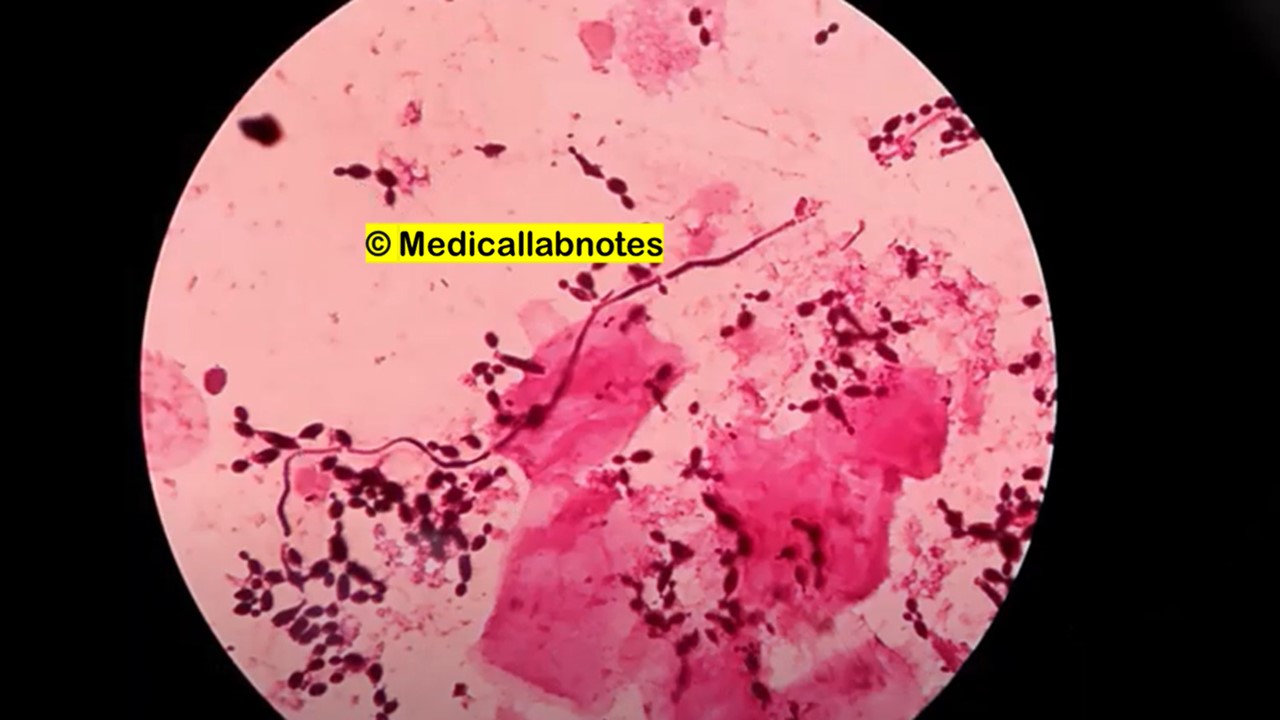
Urine Gram stainMay reveal budding yeast
Urine Culture (SDA, CHROMagar Candida)Confirm fungal growth; >10⁴–10⁵ CFU/mL significant
Repeat CultureHelps differentiate colonization vs infection
Blood cultureRule out disseminated candidiasis in high-risk cases
UrinalysisPyuria may be present; may also be sterile
Ultrasound/CT ScanDetect fungal balls or obstruction in complicated cases
Fig. Fungal elements in the KOH mount of the urine sample
Fig. Fungal growth on Sabouraud dextrose agar after 5 days of incubation at 37 °C
Fig. Aspergillus typical structure in the LPCB preparation of fungal growth on SDA
Fig. Conidia of Aspergillus in LPCB preparation
Fig. Urine sample of a patient for fungal culture and KOH mount assay
Fig. Heavy load of fungal elements in the KOH mount of the urine specimen
Fig. Colony morphology of Candida albicans on Sabouraud dextrose agar (SDA) tube
Fig. Germ tube test (GTT) of Candida albicans-Positive

Treatment

IndicationTreatment
Asymptomatic, low-risk patientNo treatment; remove catheter if possible
Symptomatic infectionFluconazole is first-line if susceptible
Fluconazole-resistant strainsUse Amphotericin B deoxycholate bladder irrigation or systemic Echinocandins
Obstructing fungal ballsSurgical removal + antifungals
Cryptococcal funguriaTreat as disseminated cryptococcosis: Amphotericin B ± Flucytosine

Prevention

  • Avoid unnecessary urinary catheters
  • Minimize broad-spectrum antibiotic use
  • Control diabetes mellitus
  • Maintain good perineal hygiene
  • Perform regular catheter care
  • Screen high-risk ICU or post-op patients if symptomatic
  • Use prophylactic antifungals in high-risk transplant or neutropenic patients selectively

Keynotes

  • Funguria is mostly due to Candida spp., especially in catheterized and ICU patients.
  • Asymptomatic cases often don’t require treatment unless risk factors exist.
  • Diagnosis depends on culture, microscopy, and clinical correlation.
  • Fluconazole remains the treatment of choice if the isolate is susceptible.
  • Prevention relies on infection control, catheter care, and antibiotic stewardship.

Further Readings

  • https://link.springer.com/article/10.1007/s003450050167
  • https://www.sciencedirect.com/science/article/abs/pii/S0924857999000321
  • https://www.merckmanuals.com/professional/genitourinary-disorders/urinary-tract-infections-utis/fungal-urinary-tract-infections
  • https://journals.sagepub.com/doi/10.1177/08850666241231495
  • https://pubmed.ncbi.nlm.nih.gov/11584989/
  • https://www.urologic.theclinics.com/article/S0094-0143(24)00062-4/pdf
  • https://www.auajournals.org/doi/pdf/10.1016/S0022-5347%2801%2967255-0
  • https://academic.oup.com/cid/article/52/suppl_6/S437/284654
  • https://www.urotoday.com/2014-09-18-02-47-34/infections-main/6523-genitourinary-fungal-infections-4949.html
  • https://pubmed.ncbi.nlm.nih.gov/17544611/
  • https://pmc.ncbi.nlm.nih.gov/articles/PMC4277144/
  • https://www.scielo.br/j/bjid/a/GYBZgBrQxBHTzFSw4NrMzdn/?lang=en
  • https://www.baus.org.uk/_userfiles/pages/files/professionals/bsot/TJW-Funguria.pdf
Medical Lab Notes

Recent Posts

First-Line Drug Susceptibility Testing (SL-DST) for Tuberculosis: Introduction, Principle, Procedure, Result-Interpretation, and Keynotes

 Introduction First-Line Drug Susceptibility Testing (FL-DST or sometimes referred to in context as SL-DST when…

5 hours ago

Hantavirus: Introduction, Morphology, Pathogenicity, Lab Diagnosis, Treatment, Prevention, and Keynotes

Introduction Hantaviruses are a group of rodent-borne viruses that cause two main life-threatening diseases in…

5 hours ago

Second-Line Drug Susceptibility Testing (SL-DST) for Tuberculosis:Introduction, Principle, Procedure, Result-Interpretation, and Keynotes

Introduction Second-line drug susceptibility testing (SL-DST) for tuberculosis is a crucial laboratory procedure designed to…

2 days ago

Red Sore on Inner Lip: Common Oral Conditions and Common Care Options

Red Sore on Inner Lip The image shows a red, oval lesion on the inner…

3 days ago

Xpert MTB/RIF: Introduction, Principle, Procedure, Result-Interpretation, Uses, and Keynotes

Introduction The Xpert MTB/RIF assay is an automated, cartridge-based molecular test used to detect Mycobacterium tuberculosis (MTB)…

3 days ago

Bacterial Load (Decoding the CFU): Introduction, Ranges, Application, and Keynotes

Introduction of Bacterial Load (Decoding the CFU) Bacterial load, measured in Colony-Forming Units (CFU), is…

4 days ago