
Introduction
Table of Contents
Orientia and Rickettsia are two closely related genera of bacteria within the family Rickettsiaceae. Both are small, gram-negative, obligate intracellular pathogens, meaning they can only grow and replicate inside the living cells of their hosts. While they share many clinical features—such as causing fever, headache, and rashes—they differ significantly in their cell wall structure and the specific vectors that transmit them to humans.
Comparison of Orientia and Rickettsia
| Feature | Orientia | Rickettsia |
| Primary Species | O. tsutsugamushi | R. rickettsii, R. typhi, R. prowazekii |
| Disease Caused | Scrub Typhus | Rocky Mountain Spotted Fever, Epidemic Typhus |
| Primary Vector | Chiggers (larval trombiculid mites) | Ticks, fleas, lice, and some mites |
| Cell Wall Structure | Lacks lipopolysaccharide (LPS) and peptidoglycan | Contains LPS and a thin peptidoglycan layer |
| Antibiotic Resistance | Historically, the “Tsutsugamushi Triangle” (Asia-Pacific) | Susceptible to various cell-wall and protein-synthesis inhibitors |
| Geographic Range | Historically the “Tsutsugamushi Triangle” (Asia-Pacific) | Worldwide distribution |
Key Differences
- Taxonomy: Orientia was formerly classified as Rickettsia tsutsugamushi but was moved to its own genus in 1995 due to distinct genetic and morphological differences.
- Cell Envelope: Orientia has a unique cell envelope with a thicker outer leaflet and lacks common bacterial components like muramic acid and glucosamine, which are present in Rickettsia.
- Clinical Presentation: Both typically cause a triad of fever, headache, and rash. However, Orientia (scrub typhus) frequently produces a characteristic black eschar (a necrotic sore) at the site of the chigger bite.
Treatment and Diagnosis
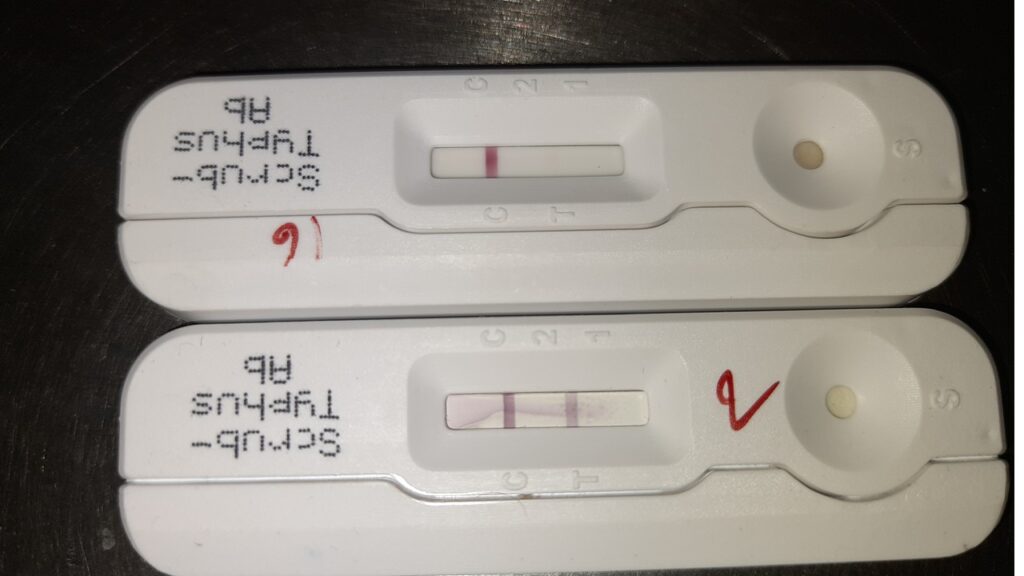
The primary treatment for infections from both genera is the antibiotic doxycycline. Because these bacteria are difficult to culture, doctors often use molecular methods like PCR or serological tests (such as IFA or ELISA) to confirm a diagnosis.
Further Readings
- https://www.sciencedirect.com/topics/agricultural-and-biological-sciences/orientia-tsutsugamushi
- https://www.cdc.gov/yellow-book/hcp/travel-associated-infections-diseases/rickettsial-diseases.html
- https://www.nature.com/articles/3880385
- https://pubmed.ncbi.nlm.nih.gov/31219004/
- https://www.sciencedirect.com/science/article/pii/S1369527423000553
- https://pubmed.ncbi.nlm.nih.gov/35383749/
- https://pmc.ncbi.nlm.nih.gov/articles/PMC6136631/
- https://www.cdc.gov/typhus/about/scrub.html
- https://www.sciencedirect.com/topics/pharmacology-toxicology-and-pharmaceutical-science/orientia-tsutsugamushi
- https://pmc.ncbi.nlm.nih.gov/articles/PMC7123480/
- https://pmc.ncbi.nlm.nih.gov/articles/PMC2650899/
- https://onlinelibrary.wiley.com/doi/pdf/10.1128/9781555817381.ch64