
Introduction
Table of Contents
Sulfonamide crystals are drug-induced urinary crystals that appear in patients receiving sulfonamide (sulfa) therapy, particularly when urine is acidic, concentrated, or dehydrated. They occur due to precipitation of unmetabolized sulfonamide compounds in urine, especially older drugs like sulfadiazine, which are less soluble in acidic pH. Their recognition is clinically important because they may indicate drug-induced crystalluria, which can lead to renal complications.
Identification Features

- Microscopic Appearance
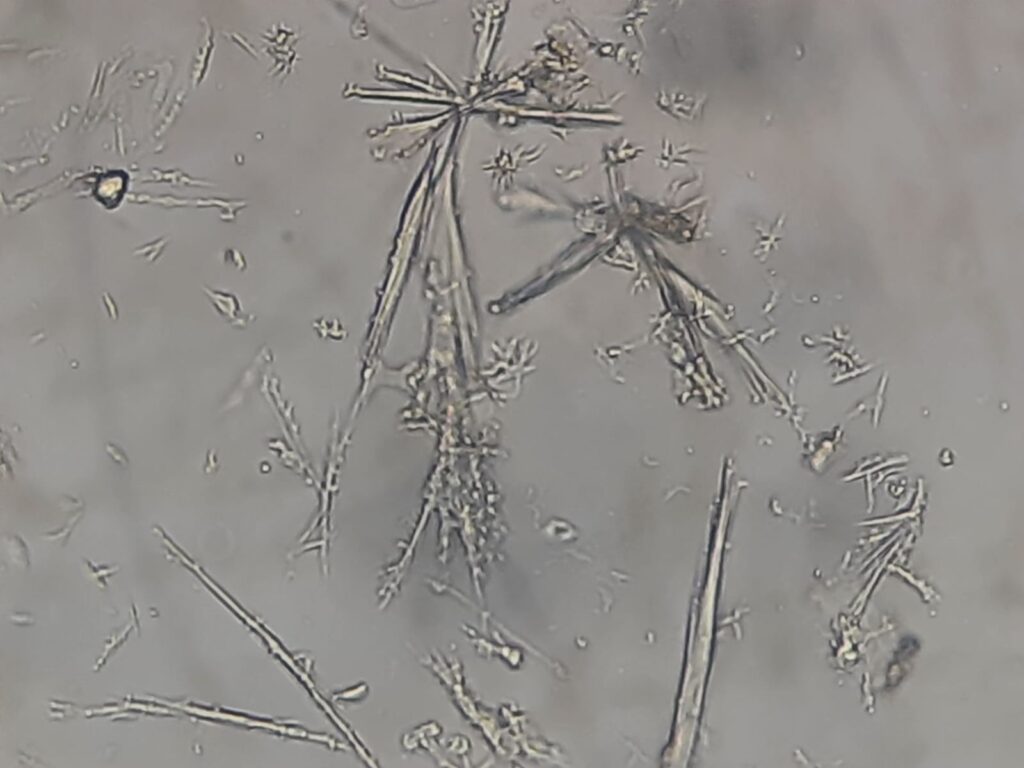
- Crystals are typically needle-shaped, fan-like, or sheaf-like clusters.
- May appear as radiating rosettes or starburst aggregates.
- It can be colorless to slightly yellowish, depending on urine concentration.
- They are highly refractile under light microscopy.
- Magnification Characteristics
- Best visualized at high power (400X).
- Appear as fine, delicate crystals, sometimes overlapping in bundles.
- Distinguishing Features from Similar Crystals
- Tyrosine crystals: fine needles in parallel clusters, often in liver disease.
- Urate crystals: reddish-brown, barrel or diamond-shaped.
- Oxalate crystals: envelope or dumbbell-shaped, not needles.

Clinical Significance
- Indicator of Sulfa Therapy: Presence usually reflects sulfonamide administration, especially sulfadiazine.
- Risk of Renal Damage: Excess crystal precipitation can cause crystalluria, hematuria, renal colic, or obstructive nephropathy.
- Risk Factors: Dehydration, acidic urine (low pH), high drug dosage, and pre-existing renal disease.
- Prevention & Management:
- Encourage hydration to dilute urine.
- Alkalinize urine with bicarbonate therapy to increase solubility.
- Monitor renal function in patients on high-dose sulfonamides.

Keynotes
- Sulfonamide crystals are iatrogenic, caused by certain medications.
- Microscopy shows needle-like, fan-shaped, or rosette clusters.
- They are significant because of their association with renal complications.
- Prevented by adequate hydration and urinary alkalinization during therapy.


Further Readings
- https://www.nature.com/articles/s41598-024-56322-9
- https://eclinpath.com/urinalysis/crystal-quick-guide/
- https://www.pathologyoutlines.com/topic/chemistryurinecrystals.html
- https://www.researchgate.net/publication/263942712_Sulfonamide_Molecular_Crystals_Structure_Sublimation_Thermodynamic_Characteristics_Molecular_Packing_Hydrogen_Bonds_Networks
- https://www.ncbi.nlm.nih.gov/books/NBK606103/
- https://www.sciencedirect.com/science/article/pii/S0022534717709809/pdf?md5=77174aa23dcd312e27b17280689922a3&pid=1-s2.0-S0022534717709809-main.pdf
- https://jamanetwork.com/journals/INTEMED/articlepdf/614174/archinte_150_11_023.pdf
- https://universe84a.com/common-urine-crystals-casts/