
Introduction
Table of Contents
HLA-B27 (Human Leukocyte Antigen B27) is a specific genetic variant of the HLA-B gene located on chromosome 6. While HLA proteins normally help the immune system distinguish between the body’s own cells and foreign invaders, the B27 variant is a well-known risk factor for a group of autoimmune disorders known as seronegative spondyloarthropathies.
Principle
The test operates on the principle of detecting either the HLA-B27 protein on the surface of lymphocytes or the HLA-B27 gene in the individual’s DNA.
- Protein Detection: Uses specific antibodies that bind to the HLA-B27 antigen if it is present on the white blood cell surface.
- Genetic Detection: Uses molecular techniques to identify the specific DNA sequence corresponding to the HLA-B27 allele.
Procedure
Testing typically involves a standard blood draw (venipuncture). Common laboratory methods include:
- Flow Cytometry: A rapid, high-throughput method where blood cells are tagged with fluorescent antibodies and passed through a laser to detect the B27 protein.
- PCR (Polymerase Chain Reaction): The current “gold standard” molecular method that amplifies and identifies the HLA-B27 gene directly from leukocyte DNA.
- Microlymphocytotoxicity (MLCT): A traditional serological method where lymphocytes are incubated with B27-specific antisera and complement; cell death indicates a positive result.
Result Interpretation
Results are generally reported as Positive or Negative.
- Positive Result: Indicates the presence of the HLA-B27 antigen/gene. This signifies a higher statistical risk for associated autoimmune disorders, but is not a diagnosis on its own.
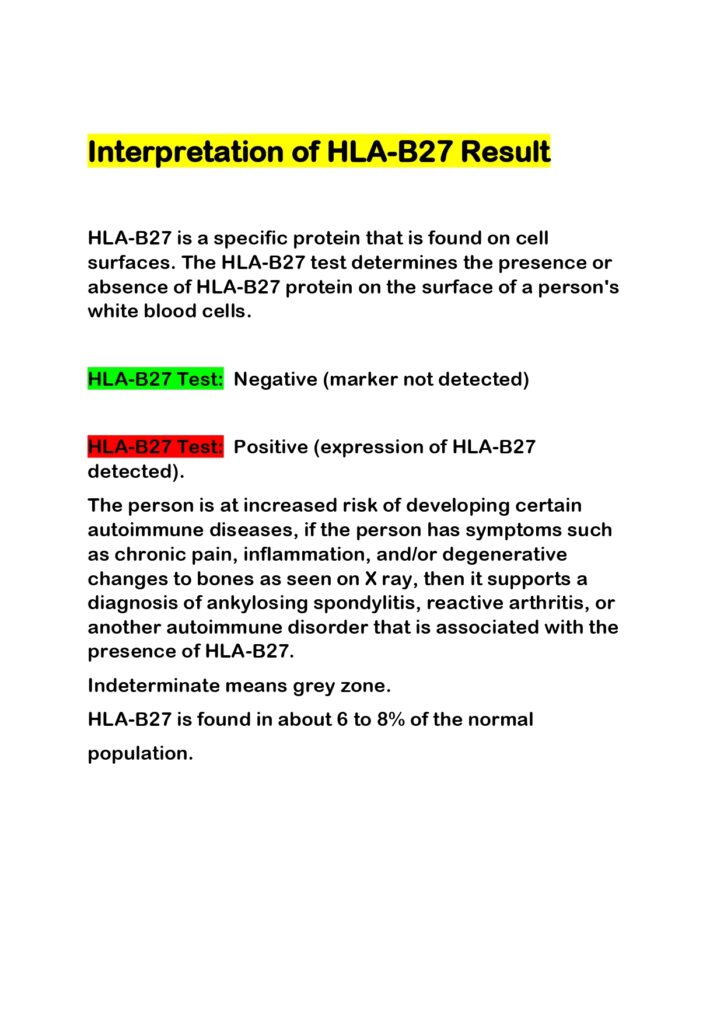
- Negative Result: Indicates the antigen was not detected. While it significantly reduces the likelihood of HLA-B27-related diseases, it does not completely rule them out, as some patients develop these conditions without the marker.
Clinical Significance
The test is primarily used to support a diagnosis of:
- Ankylosing Spondylitis (AS): Strongest association; ~90% of AS patients are HLA-B27 positive.
- Reactive Arthritis (Reiter’s Syndrome): Often triggered by an infection.
- Acute Anterior Uveitis: Recurring inflammation of the eye.
- Psoriatic Arthritis & Inflammatory Bowel Disease (IBD)-associated Arthritis: Other conditions within the seronegative spondyloarthropathy family.
Keynotes
- Not Diagnostic Alone: Most people with the HLA-B27 gene never develop an autoimmune disease.
- Demographics: Prevalence varies by ethnicity; for example, it is more common in Northern European populations and less common in African American populations.
- Lifelong Marker: Once a person tests positive, they will always be positive; the test does not need to be repeated.
- Cross-Reactivity: Some tests (like flow cytometry) may occasionally show false positives due to cross-reactivity with similar antigens like HLA-B7.
Further Readings
- https://healthservice.hse.ie/documents/8275/Testing_for_HLA_B27.pdf
- https://pmc.ncbi.nlm.nih.gov/articles/PMC6817030/
- https://www.yashodahospitals.com/diagnostics/hla-b27-test/
- https://www.apollohospitals.com/diagnostics-investigations/hla-b27-test
- https://www.metropolisindia.com/blog/health-test/hla-b27-test-overview-procedure-and-result
- https://www.carehospitals.com/diagnostics/hla-b27-test
- https://www.ucsfhealth.org/care/medical-tests/hla-b27-antigen
- https://pubmed.ncbi.nlm.nih.gov/10932047/
- https://onlinelibrary.wiley.com/doi/full/10.1002/cyto.b.22102
- https://www.researchgate.net/publication/14314330_HLA-B27_determination_using_serological_methods_A_comparison_of_enzyme_immunoassay_and_a_microlymphocytotoxic_test_with_flow_cytometry_and_a_molecular_biological_assay
- https://labtestsonline.org.uk/tests/hla-b27
- https://www.ucsfbenioffchildrens.org/medical-tests/hla-b27-antigen
- https://punerheumatologist.com/blogs/hla-b27-test-ankylosing-spondylitis-facts/
- https://redcliffelabs.com/hla-b27-flow-cytometry
- https://www.ganeshdiagnostic.com/blog/what-is-hla-b27-pcr-test