
Introduction
Table of Contents
The Rapid Diagnostic Test (RDT) for Visceral Leishmaniasis (VL), often known as the rK39 test or Kalazar Detect™, is a specific, non-invasive immunochromatographic assay used to detect antibodies against Leishmania parasites in human serum or blood.
Visceral Leishmaniasis (Kala-azar) is a severe, potentially fatal vector-borne disease caused by Leishmania parasites. RDTs are critical innovations in control programs because they provide fast results (within 10–20 minutes) and are field-friendly, requiring no specialized laboratory equipment or refrigeration.
Principle
The test operates on the principle of lateral flow immunochromatography.
- Antigen: It uses the recombinant rK39 antigen, which is a 39-amino-acid repeat segment from the kinesin-related protein found in Leishmania species like L. donovani and L. infantum.
- Mechanism: The test membrane is pre-coated with rK39 at the test line and a control antibody (e.g., chicken anti-protein A) at the control line. When a sample containing anti-rK39 antibodies is added, it reacts with a dye conjugate (like colloidal gold). This complex migrates up the strip and is captured by the immobilized rK39, forming a visible colored line.
Procedure (e.g., InBios Kalazar Detect™)
- Sample Collection: Collect approximately 20 μL of serum or one drop of finger-prick blood.
- Application: Add the sample to the designated sample pad area at the base of the dipstick.
- Buffer Addition: Place the dipstick vertically into a test tube or well containing 2–3 drops (approx. 150 μL) of chase buffer.
- Incubation: Wait for exactly 10 minutes before reading the results.
Result Interpretation of Rapid Diagnostic Test for Visceral Leishmaniasis
Results must be interpreted within the specified timeframe to avoid misleading readings.
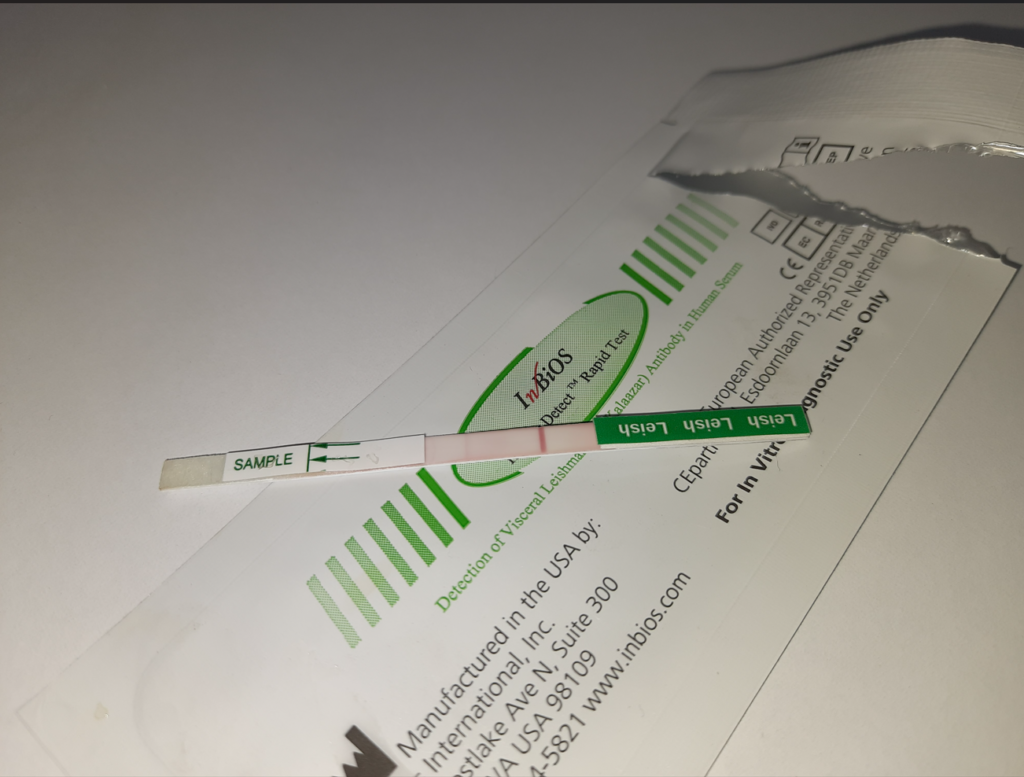
| Result Type | Appearance | Meaning |
| Positive | Two red lines appear: one at the control (C) area and one at the test (T) area. | Antibodies to VL detected; consistent with infection. |
| Negative | Only one red line appears at the control (C) area. | No antibodies detected. |
| Invalid | No line appears at the control (C) area, even if a line appears at the test area. | Test failed; repeat with a new strip. |
Clinical Significance of Rapid Diagnostic Test for Visceral Leishmaniasis
- High Performance: In the Indian subcontinent, the rK39 test has high sensitivity (97%) and specificity, making it a reliable indicator for diagnosis.
- Bedside Diagnosis: Its ease of use allows for diagnosis in peripheral health centers, ensuring patients receive prompt treatment without traveling to distant hospitals.
- Limitations:
- Asymptomatic Positives: Some healthy individuals in endemic areas may test positive due to past exposure or subclinical infection.
- Regional Variation: Sensitivity is lower in East Africa (~85%) compared to India.
- HIV Co-infection: The test may have lower accuracy in patients co-infected with HIV.
Keynotes
- Not a Test of Cure: Because antibodies persist for months or even years after recovery, the RDT cannot be used to monitor treatment success or diagnose a relapse.
- Clinical Context: The test should only be applied to patients who already meet the clinical case definition for VL (e.g., prolonged fever >2 weeks and splenomegaly).
- Storage: Most kits are stable at room temperature (20°C–30°C), which is essential for use in tropical endemic regions.
Further Readings
- http://inbios.com/wp-content/uploads/2016/06/900003-12-CE-Marked-Kalazar-Detect-Rapid-Test-Human-Insert.pdf
- https://www.elsevier.es/en-revista-clinics-22-articulo-visceral-leishmaniasis-diagnosis-rapid-test-S1807593222004082
- https://pmc.ncbi.nlm.nih.gov/articles/PMC4468926/
- https://pmc.ncbi.nlm.nih.gov/articles/PMC9609364/
- https://universe84a.com/collection/rk39-test-result-visceral-leishmaniasis/
- https://medicallabnotes.com/immunochromatographic-test-ict-introduction-principletest-requirements-procedure-result-interpretation-uses-and-ict-footages/
- https://pmc.ncbi.nlm.nih.gov/articles/PMC2999003/
- https://www.researchgate.net/figure/Figure-1-rK39-Immunochromatographic-dipstick-test-for-kala-azar_fig1_281773800
- https://www.researchgate.net/figure/rK39-immunochromatographic-strip-test-results-Strips-with-only-the-control-band-dog-IDs_fig2_304908536
- https://inbios.com/product/kalazar-detect-rapid-test-for-visceral-leishmaniasis-intl/
- http://inbios.com/wp-content/uploads/2016/06/Kalazar-11.08-high-res.pdf
- https://iris.who.int/bitstreams/8144f5e4-a1d5-41cb-8b67-9d8fa3be0582/download
- https://journals.asm.org/doi/10.1128/cvi.00174-08
- https://www.elsevier.es/es-revista-clinics-22-articulo-visceral-leishmaniasis-diagnosis-rapid-test-S1807593222004082?referer=buscador