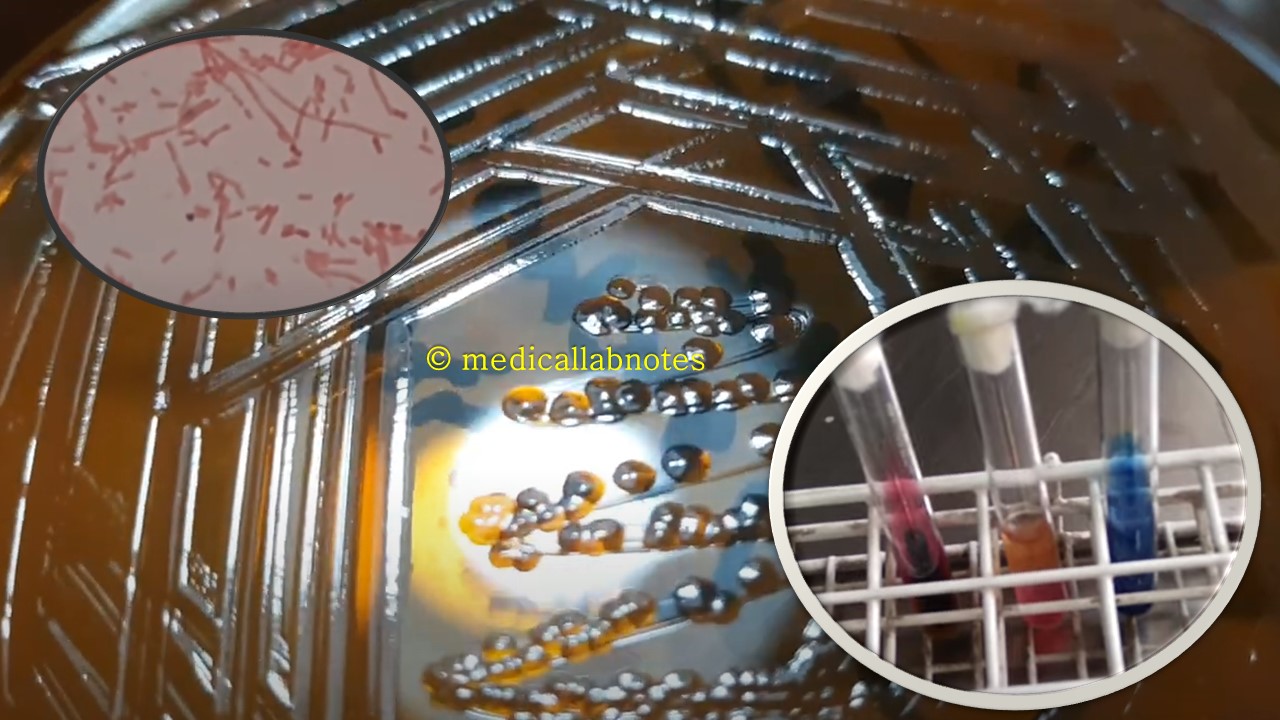
Gram-negative bacilli bacteria: Introduction, List of Bacteria, Keynotes, and Related Footage

Introduction of Gram-Negative Bacilli (GNB) Bacteria ‘Gram Positive Negative (GNB)‘ is also called Gram Negative Rods (GNR) bacteria which take safranin after decolorization and stain pink or red on Gram’s staining. The most of GNR bacteria are medically important and among them few are Escherichia …

Read more

Vibrio cholerae: Introduction, Identification Features, Keynotes, and Vibrio Footages

Vibrio cholerae: Introduction, Identification Features, Keynotes, and Vibrio Footages

Introduction The genus, Vibrio is a member of the family, Vibrionaceae and the most common human pathogens are Vibrio cholerae, V. parahaemolyticus, and V. vulnificus. Vibrio cholerae is a species of Gram-negative, motile, non-sporing, and non-capsulated, facultative anaerobe and comma-shaped bacterium. It is a ubiquitous …

Read more

Gram Positive Bacilli or Rods: Introduction, List of Bacteria, Keynotes, and Related Pictures

Bacillus in Gram staining

Introduction of Gram Positive Rods (GPR) ‘Gram Positive Bacilli (GPB)‘ is also called Gram Positive Rods (GPR) bacteria which retain crystal violet dye and stain blue or purple on Gram’s staining. The most common medically important bacteria of GPR are Mycobacterium tuberculosis, Mycobacterium leprae, Listeria monocytogenes, …

Read more

Hemolysis and Hemodigestion: Introduction, Differences, and Related Footages

Hemolysis and Hemodigestion- Introduction, Differences, and Related Footages

Introduction of Hemolysis and Hemodigestion When the pure isolated colony of organism on a blood agar plate is exposed in bright transmitted light, we differentiate between hemolysis and hemodigestion since hemolysis is the process of killing blood cells by bacteria, and the area surrounding a …

Read more

Pseudomonas aeruginosa: Introduction, Identification Features, Keynotes, and Pseudomonas Footages

Pseudomonas aeruginosa: Introduction, Identification Features, Keynotes, and Pseudomonas Footages

Introduction of Pseudomonas aeruginosa Pseudomonas aeruginosa is a widely distributed environment like in soil and water, Gram-negative rods, aerobic, motile due to having a polar flagellum, non-sporing, non- capsulated but many strains have mucoid slime layer, produce water-soluble pigments and opportunistic pathogens of size 1.5 – …

Read more

Proteus mirabilis: Introduction, Identification Features, Keynotes, and Proteus Footages

Proteus mirabilis-Introduction, Identification Features, Keynotes, and Proteus Footages

Introduction of Proteus mirabilis The genus Proteus was discovered in 1885 by Hauser and it is also named after a Greek god.  Proteus is a member of the family, Enterobacteriaceae and it is a Gram-negative, oxidase-negative, fimbriated, motile, non-sporing rod-shaped bacterium without capsule and having a size …

Read more

Bile Esculin Test: Introduction, Principle, Test Requirements, Procedure, Result Interpretation, Uses, Limitation, Keynotes, and Related Footages

Bile Esculin Test: Introduction, Principle, Test Requirements, Procedure, Result Interpretation, Uses, Limitation, Keynotes, and Related Footages

Introduction of Bile Esculin test Bile esculin test is widely used to differentiate Enterococci from streptococci, other than streptococcus bovis as well as Yersinia enterocolitica from food and animal feeding stuff and Listeria monocytogenes which are bile tolerant and can hydrolyze esculin to esculetin, it reacts …

Read more

Working Hypochlorite Preparation: Introduction, Preparation Requirements, Procedure, and Keynotes

1% hypochlorite (bleach) preparation

Introduction of Hypochlorite Sodium hypochlorite (NaOCl) is a compound that is a clear, slightly yellowish solution with a characteristic odor and it can be effectively applied for water purification as well as on a large scale for surface purification, bleaching, odor removal, and water disinfection. …

Read more