
Introduction
Table of Contents
TB-LAMP (Tuberculosis Loop-Mediated Isothermal Amplification) is a manual, rapid molecular diagnostic test endorsed by the World Health Organization (WHO) to detect the Mycobacterium tuberculosis complex (MTBC) in sputum samples. It serves as a highly sensitive alternative to traditional sputum smear microscopy, particularly optimized for resource-limited and peripheral healthcare settings.
Principle
TB-LAMP relies on auto-cycling, high-efficiency DNA strand displacement activity driven by the Bst DNA polymerase enzyme under isothermal conditions (a constant temperature of roughly 64°C to 67°C). Unlike conventional Polymerase Chain Reaction (PCR), it does not require an expensive thermal cycler machine.
- Primer Specificity: The assay utilizes 6 specialized primers that recognize 8 distinct regions on the target MTBC DNA sequence, ensuring exceptional diagnostic specificity.
- Loop Primers: Added loop primers accelerate the reaction, enabling a 10⁹ to 10¹⁰-fold DNA amplification within 30 to 40 minutes.
- Detection Chemistry: The reaction generates a massive amount of DNA and a byproduct called magnesium pyrophosphate. Visual detection is enabled by a double-stranded DNA-binding fluorescent dye (such as calcein) already integrated into the reaction tubes.
Procedure
The commercial Loopamp™ MTBC Detection Kit by Eiken Chemical Co. follows a streamlined, four-step workflow that takes less than two hours to complete:
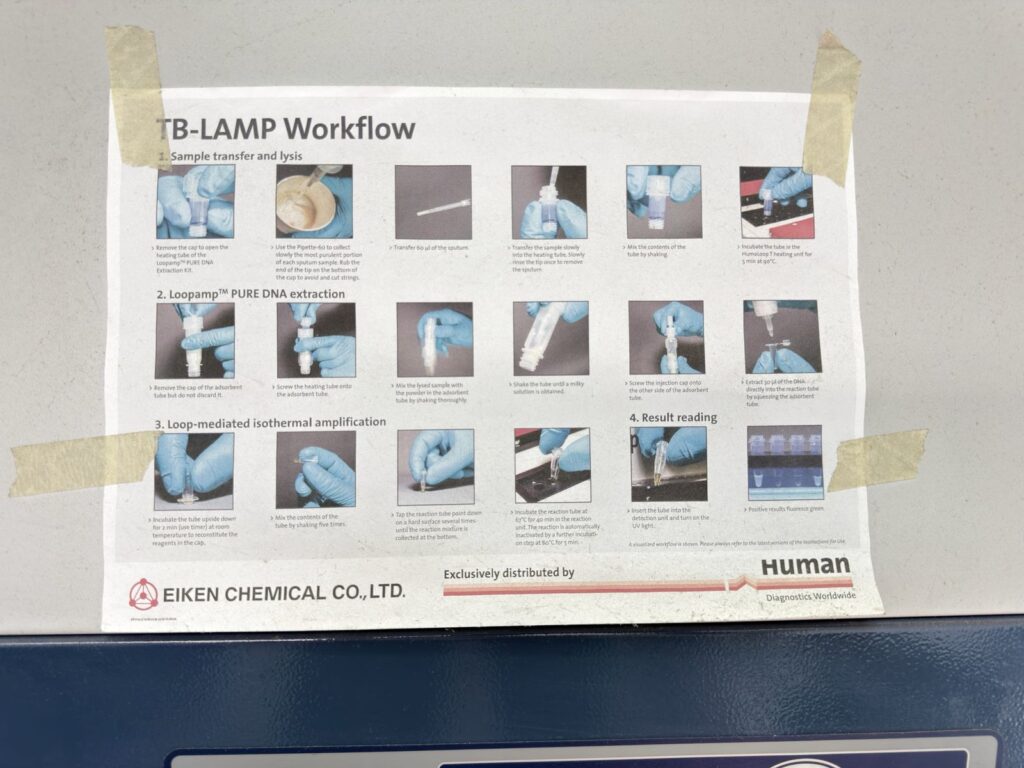
1. Sample Transfer and Lysis
- Collect 60 μL to 120 μL of raw sputum using a wide-bore matching pipette.
- Transfer it into a heating tube filled with extraction/lysis buffer.
- Mix well and incubate inside a heating block (such as the HumaLoop T unit) at 90°C for 5 minutes to lyse cells and inactivate the pathogen safely.
- Allow the mix to cool down for 2 minutes.
2. Loopamp™ PURE DNA Extraction
- Screw an adsorbent tube tightly onto the heating tube to pierce its inner seal.
- Shake thoroughly to bind potential PCR inhibitors to the specialized powder matrix within the adsorbent column.
- Fit a delivery nozzle onto the tube and squeeze to express exactly 30 μL of purified DNA eluate directly into the reaction tube.
3. Isothermal Amplification
- Invert the reaction tubes several times to fully dissolve the dried LAMP reagents localized inside the tube cap.
- Place the mixed tubes into the heating block chamber set precisely at 67°C for 40 minutes.
- The system automatically stops the reaction once the amplification timer runs out.
4. Result Reading
- Immediately move the intact, unopened reaction tubes over to the accompanying fluorescence detection slot.
- Observe the visual color reaction under ultraviolet (UV) or LED light.
Result Interpretation
Results are interpreted visually with the naked eye under UV/LED light based on comparative fluorescence:
| Visual Appearance Under UV/LED Light | Result Interpretation | Clinical Status |
| Intense, bright green fluorescence | Positive | Mycobacterium tuberculosis complex DNA is detected. |
| Clear / No fluorescence (remains dark) | Negative | MTBC DNA is not detected in the sample. |
| No fluorescence in Positive Control OR Green fluorescence in Negative Control | Invalid | Test run failed. Must repeat the process using a new kit batch. |
Keynotes
- Infrastructure Benefits: It acts as a point-of-care (POC) asset because it only requires a basic heating block and a steady power source (which can be safely supplemented by portable solar panels or external batteries in remote clinics).
- No Drug Resistance Mapping: Unlike GeneXpert (Xpert MTB/RIF), TB-LAMP cannot detect genetic markers for drug resistance (e.g., rifampicin resistance). It acts solely as a binary diagnostic identifier for active TB cases.
- Sputum Limitations: The WHO validates TB-LAMP performance primarily for direct raw sputum collection. Other non-invasive clinical materials (urine, blood plasma, or CSF) have not yet been globally standardized for this specific system.
- Treatment Monitoring: Because it amplifies target DNA segments, TB-LAMP will return positive outcomes from both live and dead bacilli. Consequently, conventional sputum smear microscopy remains necessary to monitor patient response to ongoing anti-TB drug regimens.
- Quality Control Overhead: Every individual testing cycle batch requires running distinct positive and negative controls alongside patient samples, adding minor cost footprints to operations.
Further Readings
- https://www.sciencedirect.com/science/article/abs/pii/S0163445314002783
- https://www.ncbi.nlm.nih.gov/books/NBK384523/
- https://iris.who.int/server/api/core/bitstreams/9c80d4ed-0c98-4833-b04b-ee6ac7733f55/content
- https://www.oatext.com/evaluation-of-tb-lamp-assay-for-the-diagnosis-of-pulmonary-tuberculosis-in-lusaka-zambia.php
- https://www.moleculartb.org/files/documents/55
- https://jidc.org/index.php/journal/article/download/38635619/3306/200274
- https://unair.ac.id/lamp-simple-fast-and-accurate-alternative-method-of-tb-diagnosis/
- https://pmc.ncbi.nlm.nih.gov/articles/PMC12618186/
- https://www.eiken.co.jp/en/ourfields/infection/lamp_operation/
- https://journals.plos.org/plosone/article/file?type=printable&id=10.1371/journal.pone.0253235
- https://www.thelancet.com/journals/lanmic/article/PIIS2666-5247(25)00097-7/fulltext
- https://www.stoptb.org/sites/default/files/imported/document/TB_LAMP_info_note.pdf
- https://www.researchgate.net/figure/Specificity-of-the-RT-LAMP-assay-2A-Agarose-gel-electrophoresis-of-the-RT-LAMP_fig3_227161162