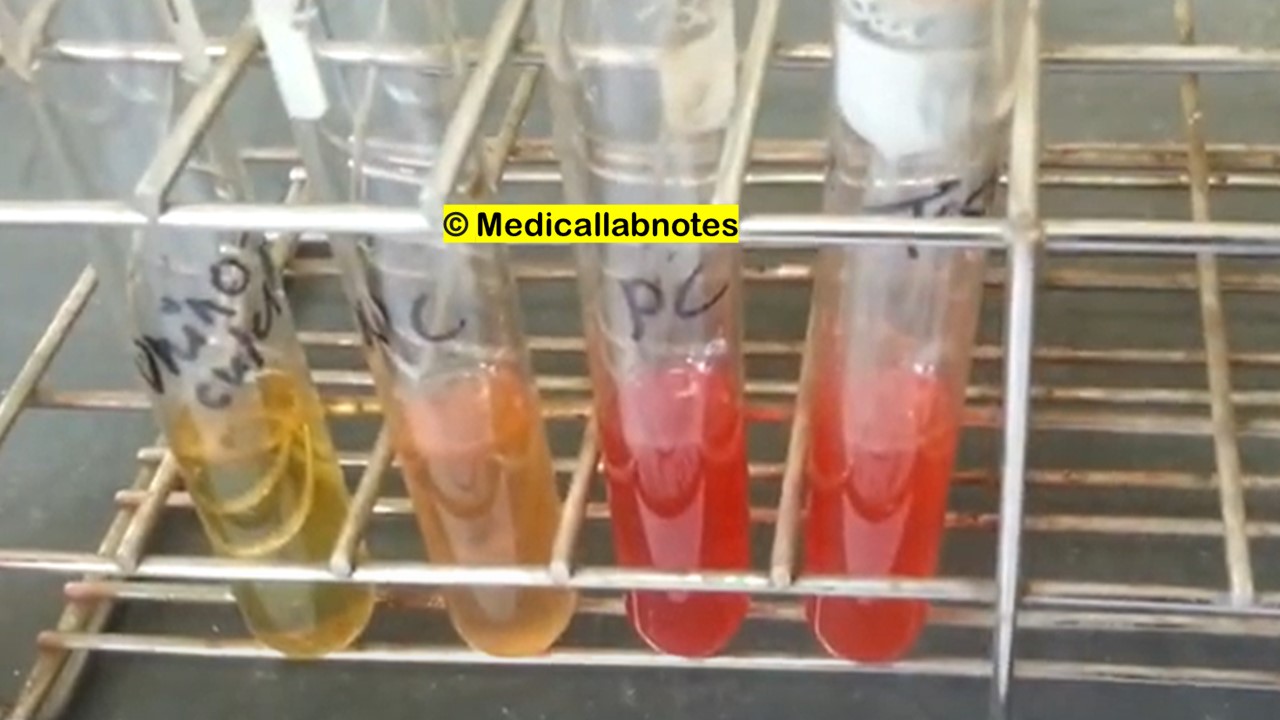
Indoxyl Acetate Disk Test: Introduction, Principle, Test Requirements, Procedure, Result-Interpretation, Limitations, and Keynotes

Indoxyl Acetate Disk Test-Positive and Negative Results

Introduction of Indoxyl Acetate Disk Test  Indoxyl is a tryptophan product of putrefactive decomposition in the intestines of humans by a bacterial esterase. This Indoxyl Acetate Disk test uses to distinguish Campylobacter species. Positive tests are Campylobacter jejuni and Campylobacter coli whereas Campylobacter lari and Campylobacter fetus are negative. Principle of Indoxyl Acetate Disk Assay The …

Read more

Hippurate Hydrolysis Test: Introduction, Principle, Test Requirements, Procedure, Result-Interpretation, Limitations, and Keynotes

Hippurate Hydrolysis Test-Positive and Negative Results

Introduction of Hippurate Hydrolysis Test The Hippurate Hydrolysis Test is applied to determine the ability of the organism to produce hippuricase which hydrolyzes the substrate hippurate. It is useful in the identification of Streptococcus agalactiae, Campylobacter jejuni, Listeria monocytogenes, and Gardnerella vaginalis.  Principle of the Test The end products …

Read more

LAP (Leucine Aminopeptidase) Test: Introduction, Principle, Test Requirements, Procedure, Result -Interpretation, and Limitations

 LAP (Leucine Aminopeptidase) Test-Positive and Negative Bacteria

Introduction of LAP (Leucine Aminopeptidase) Test LAP stands for leucine aminopeptidase which is an enzyme useful for definitive identification of catalase-negative, gram-positive cocci of Aerococcus and Leuconostoc (LAP test negative) from other organisms in the group like  Streptococcus, Enterococcus, Lactococcus, and Pediococcus (almost always positive). Principle of LAP test Hydrolysis of the leucine-pnaphthylamide substrate by …

Read more

Microbiology Reporting Methods: Introduction, List of Templates, and Keynotes

Salmonella Typhi isolated from blood culture-Growth on Nutrient agar, blood agar and MacConkey medium, Biochemical reactions in TSI, SIM,Citrate and Urea agar, and growth on broth medium (blood culture bottle)-demonstration

Introduction of Microbiology Reporting Methods Microbiology Reporting Methods are useful to provide similar report formats from different Microbiology Laboratory platforms that should sound Microbiologically clear and concise. It should also be compatible with International Guidelines of Clinical Microbiology Practice like the Clinical & Laboratory Standards …

Read more

XLD Agar: Introduction, Composition, Principle, Preparation, Test Requirements, Procedure, Colony Characteristics, Modifications, Uses, and Limitations

Salmonella Typhi (black colony) and Shigella growth on xylose lysine deoxycholate (XLD) agar

Introduction of XLD Agar XLD agar is a selective, differential, and indicator medium for the isolation of enteric pathogens. XLD stands for xylose lysine deoxycholate. It also supports the growth of more fastidious enteric organisms. XLD agar was developed by Taylor. It was specially designed to allow the …

Read more

Mannitol Salt Agar (MSA): Introduction, Composition, Principle, Test Requirement, Procedure, Result -Interpretation, Limitation, and Keynotes

Staphylococcus aureus , CoNS and inhibited growth of Escherichia coli on MSA

Introduction of Mannitol salt agar (MSA) Mannitol Salt Agar (MSA) is a selective, differential, and indicator medium which is used to isolate and identify S. aureus from clinical and non-clinical specimens. Other Staphylococcus species and Micrococcus also grow on this medium. Selective is due to very high salt (7.5%) compared with other media. Gram-Positive Staphylococcus: …

Read more

TCBS Agar : Introduction, Composition,Principle, Test Requirement,Procedure, Result -Interpretation, Limitation, and Keynotes

Vibrio cholerae colony morphology on TCBS agar

Introduction of TCBS Agar Vibrio cholerae is the causative agent of cholera and Thiosulfate Citrate bile salts sucrose (TCBS) agar is a selective as well as differential culture medium used for selective isolation of this bacterium including its species from a variety of clinical and nonclinical specimens. TCBS agar …

Read more

AST Pattern of Bacteria: Introduction, Group of AST Pattern, List of Antimicrobial Agents, and Keynotes

Antibiotic Susceptibility Testing (AST)-Kirby-Bauer Disk Diffusion Method

AST Pattern of Bacteria AST Pattern of Bacteria covers common bacterial pathogens groups like Enterobacteriaceae, Staphylococcus, Enterococcus, Pseudomonas aeruginosa, Streptococcus pneumoniae, beta-haemolytic streptococci (Streptococcus pyogenes, Streptococcus agalactiae), Haemophilus species, Acinetobacter, Viridans group of streptococci, Shigella, and Neisseria species. Enterobacteriaceae Antimicrobial Agents- Zone Diameter (Intermediate) Extra …

Read more