Staphylococcus lentus: Introduction, Morphology, Pathogenicity, Lab Diagnosis, Treatment, Prevention, and Keynotes

Serratia ficaria on CLED Agar of Urine Culture

Introduction Staphylococcus lentus is a species of Gram-positive bacteria belonging to the genus Staphylococcus. It is classified as a coagulase-negative staphylococcus (CoNS), which means it does not produce the enzyme coagulase. CoNS are commonly found as part of the normal human skin and mucous membrane …

Read more

Aeromonas sobria: Introduction, Morphology, Pathogenicity, Lab Diagnosis, Treatment, Prevention, and Keynotes

Aeromonas sobria colony morphology on CLED agar of Urine Culture after 4 days of incubation

Introduction Aeromonas sobria is a species of Gram-negative bacteria that belongs to the Aeromonas genus. It is a rod-shaped, facultative anaerobic bacterium that is commonly found in aquatic environments, such as freshwater and brackish water. A. sobria can cause a range of infections in humans, …

Read more

Pantoea: Introduction, Classification Morphology, Pathogenicity, Lab Diagnosis, Treatment, and Prevention

Pantoea in Gram Staining of Culture Microscopy at Magnification of 4000X

Introduction Pantoea is a genus of gram-negative bacteria that belong to the family Enterobacteriaceae. These bacteria are commonly found in soil, water, and plant surfaces, and some species are known to be associated with plants, animals, and humans as opportunistic pathogens. There are several species …

Read more

Motility of Bacteria: Introduction, List of Motile and Non-motile Bacteria, Keynotes, and Related Videos

Introduction For Motility of Bacteria Bacteria are motile due to having flagella (singular -flagellum). Some common motile bacteria are E.coli, Salmonella, Proteus, Pseudomonas, Citrobacter, and Enterobacter while non-motile are Klebsiella, Shigella, and Acinetobacter. Motility Types of Different Microbes S.No Motility Types Microbes 1. Darting Motility …

Read more

MR-VP Test: Introduction, Principle, Test Requirement, Procedure, Result- Interpretation, and Keynotes

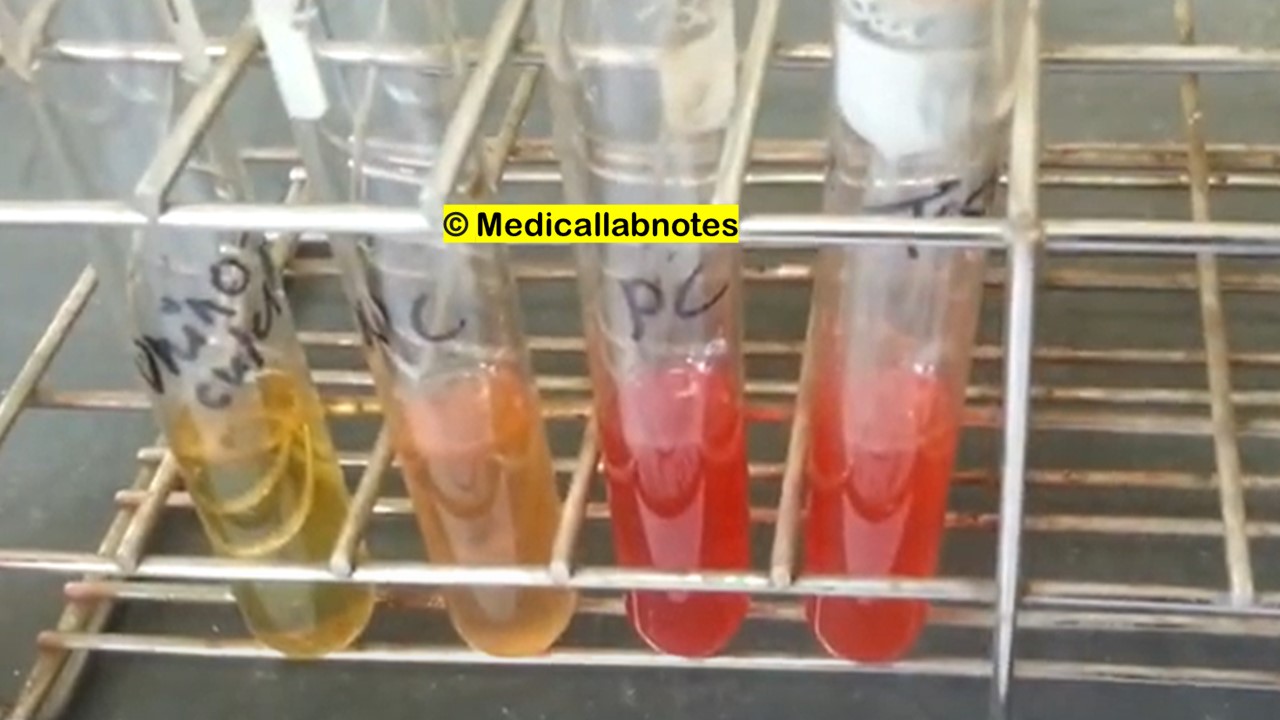
Result and Interpretation of Voges Proskauer Test

Introduction of MR-VP Test MR-VP test stands for Methyl Red –Voges Proskauer Test. MR-VP test will be discussed in two tests separately. One is for Methyl Red (MR) test and while other is for Voges Proskauer (VP)test. Introduction of Methyl Red Test The Methyl Red test is …

Read more

Voges Proskauer Test: Introduction, Principle, Test Requirements, Test Procedure, Result-Interpretation, Positive and Negative Bacteria, and Limitations

Voges Proskauer Test Reagents, Negative and Positive Test Results of VP Tests

Voges-Proskauer (VP ) Test Voges Proskauer  test for identification to the species level of the following groups of organisms Principle of Voges Proskauer Test Organisms utilizing the butylene glycol pathway produce acetylmethylcarbinol (acetoin) and butanediol, neutral end products that raise the pH towards neutrality (pH …

Read more

Methyl Red Test: Introduction, Principle, Test Requirements, Test Procedure, Result-Interpretation, Positive and Negative Bacteria, and Limitations

Methyl Red Test-Positive and Negative Test Results

Introduction of Methyl Red Test The Methyl Red test is for enteric gram-negative rods, as part of identification to species level. Its short name is MR test. Principle of Methyl Red Test The methyl red (MR) test uses to determine if an organism is able …

Read more

Escherichia hermanii: Introduction, Classification, Pathogenecity, Lab Diagnosis, Treatment, and Keynotes

Escherichia hermanii colony morphology on MacConkey agar

Introduction of Escherichia hermanii Escherichia hermannii is a gram-negative rod. This bacterium belongs to the family of Enterobacteriaceae. It was first described in 1982. It had been previously known as enteric group 11 of Escherichia coli but was later reclassified as a distinct species in …

Read more