Brain heart infusion (BHI) Broth: Introduction, Composition, Principle, Preparation, Test Procedure, Result-Interpretation, Modifications, Uses, and Keynotes

Blood inoculated BHI broth after 4 days of incubation showing bacterial growth

Introduction of BHI Broth Brain Heart Infusion (BHI) broth is a highly nutritive medium and is thus useful for cultivating a wide variety of microorganisms like aerobic and anaerobic bacteria, yeasts, and molds.  BHI broth is commonly used in blood culture work and allied pathological …

Read more

Staphylococcus aureus: Introduction, Pathogenicity, Lab Diagnosis, Treatment, and Keynotes

Staphylococcus aureus: Introduction, Pathogenicity, Lab Diagnosis, Treatment, and Keynotes

Introduction of Staphylococcus aureus Scientific classification of Staphylococcus aureus is given as: Domain Bacteria Phylum Firmicutes Class Bacilli Order Bacillales Family Staphylococceae Genus Staphylococcus Species aureus Table: Biological Classification of Staphylococcus aureus Staphyle means bunch and Kokko mean berry. Staphylococcus aureus was isolated by Pasteur (1880) from a pus sample. …

Read more

CLED Agar: Introduction, Composition, Principle, Preparation, Testing Procedure, Colony Characteristics, Modifications, Limitations, and Keynotes

Staphylococcus aureus (11 o'clock) Klebsiella pneumoniae (5 o'clock) and Pseudomonas aeruginosa (8 o'clock) growth on CLED agar-Back View

Introduction of CLED Agar CLED stands for cysteine, lactose, and electrolyte-deficient. CLED agar or medium is a differential culture medium used for the isolation and enumeration of bacteria in urine specimens from suspected cases of urinary tract infection (UTI). It favors the growth of all …

Read more

MacConkey Agar: Introduction, Principle, Composition, Preparation, Procedure, Colony Morphology, Uses, and Keynotes

MacConkey Agar: Introduction, Principle, Composition, Preparation, Procedure, Colony Morphology, Uses, and Keynotes

Introduction of MacConkey Agar MacConkey agar (MAC) uses for the culture of gram-negative bacteria and therefore Enterobacteriaceae belonging bacteria grow well on this medium and coliforms also enjoy this medium. MAC is a modification of Neutral Red Bile Salt Agar developed by MacConkey. It was one of the …

Read more

Vibrio cholerae: Introduction, Identification Features, Keynotes, and Vibrio Footages

Vibrio cholerae: Introduction, Identification Features, Keynotes, and Vibrio Footages

Introduction The genus, Vibrio is a member of the family, Vibrionaceae and the most common human pathogens are Vibrio cholerae, V. parahaemolyticus, and V. vulnificus. Vibrio cholerae is a species of Gram-negative, motile, non-sporing, and non-capsulated, facultative anaerobe and comma-shaped bacterium. It is a ubiquitous …

Read more

Proteus mirabilis: Introduction, Identification Features, Keynotes, and Proteus Footages

Proteus mirabilis-Introduction, Identification Features, Keynotes, and Proteus Footages

Introduction of Proteus mirabilis The genus Proteus was discovered in 1885 by Hauser and it is also named after a Greek god.  Proteus is a member of the family, Enterobacteriaceae and it is a Gram-negative, oxidase-negative, fimbriated, motile, non-sporing rod-shaped bacterium without capsule and having a size …

Read more

Bile Esculin Test: Introduction, Principle, Test Requirements, Procedure, Result Interpretation, Uses, Limitation, Keynotes, and Related Footages

Bile Esculin Test: Introduction, Principle, Test Requirements, Procedure, Result Interpretation, Uses, Limitation, Keynotes, and Related Footages

Introduction of Bile Esculin test Bile esculin test is widely used to differentiate Enterococci from streptococci, other than streptococcus bovis as well as Yersinia enterocolitica from food and animal feeding stuff and Listeria monocytogenes which are bile tolerant and can hydrolyze esculin to esculetin, it reacts …

Read more

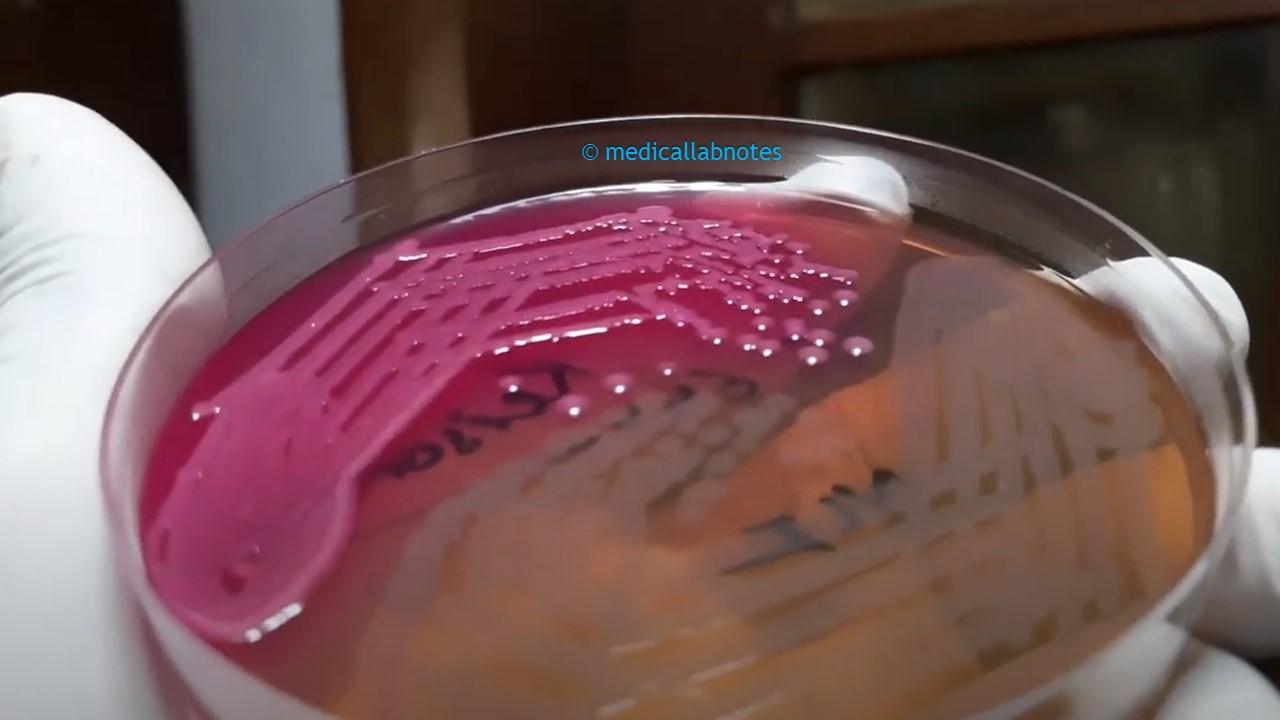
Lactose Fermenter (LF) and Non-Lactose Fermenter (NLF) Gram-Negative Bacteria: Introduction, List of LF and NLF Bacteria, and Keynotes

LF and NLF Colonies of Klebsiella and Pseudomonas on MacConkey medium

Introduction of LF and NLF Gram-Negative Bacteria on MacConkey Medium MacConkey agar/ medium is recommended for use as a selective, differential, and indicator growth medium for the isolation of gram-negative bacilli including coliform organisms and enteric pathogens, on the basis of lactose fermentation. Peptones (meat …

Read more