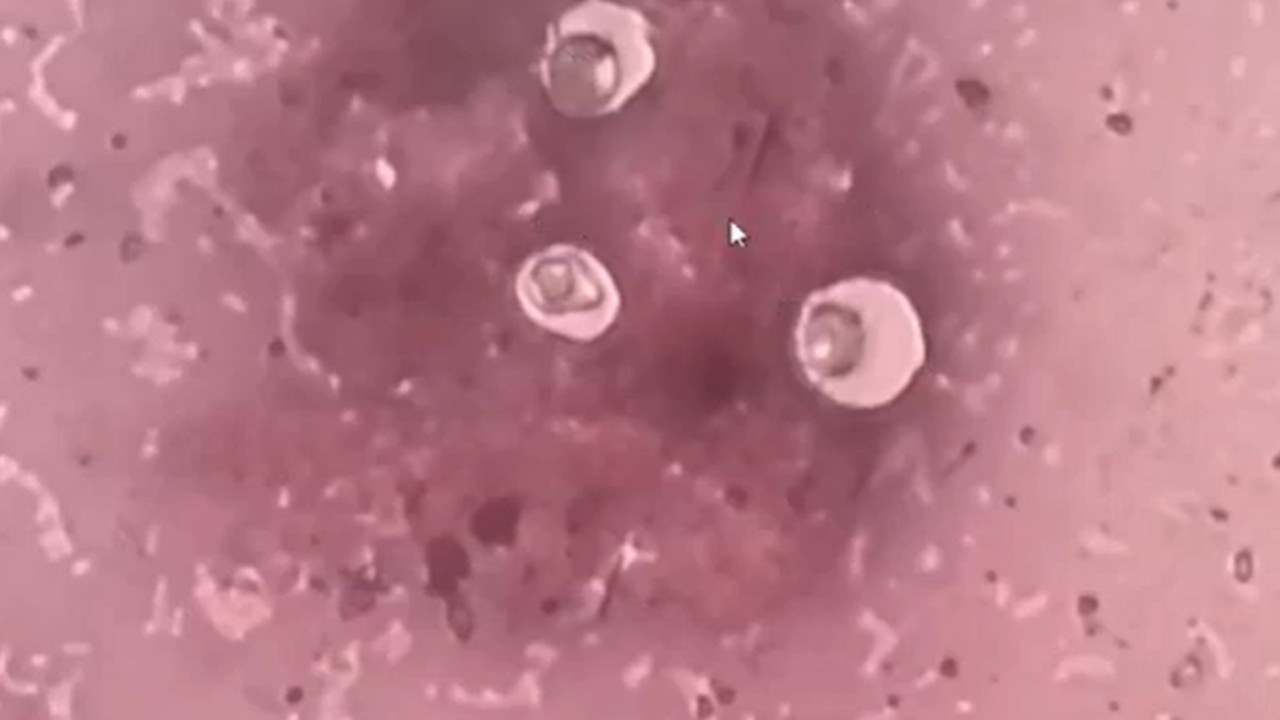
Diagnostic Challenge: LD Bodies vs Pneumocystis Vs Histoplasma in Giemsa-Stained BAL

Found in Giemsa staining of BAL-Possible pathogen?

Found in Giemsa staining of BAL. Possible pathogen? Morphological Features (Center) Possible Pathogen Supporting Features for Pneumocystis Recommendations Is it possible to be LD bodies? Based on the Giemsa-stained BAL image: The central violet-stained cluster of intracellular forms could resemble Leishman-Donovan (LD) bodies, especially in …

Read more

MDR Candida NGS:Introduction, Principle, Test Requirements, Procedure, Result-Interpretation, Clinical Significance, and Keynotes

MDR Candida NGS:Introduction, Principle, Test Requirements, Procedure, Result-Interpretation, Clinical Significance, and Keynotes

 Introduction of MDR Candida NGS MDR Candida NGS refers to the use of Next-Generation Sequencing for the detection, identification, and resistance gene profiling of multidrug-resistant (MDR) Candida species, such as Candida auris, Candida glabrata, and others resistant to azoles, echinocandins, or polyenes. Next-generation sequencing (NGS) …

Read more

Pneumocystis PCR: Introduction, Principle, Test Requirements, Procedure, Result-Interpretation, Clinical Significance, and Keynotes

Pneumocystis PCR: Introduction, Principle, Test Requirements, Procedure, Result-Interpretation, Clinical Significance, and Keynotes

Introduction Pneumocystis PCR is a molecular diagnostic tool used for the detection of Pneumocystis jirovecii DNA in respiratory specimens, especially in immunocompromised patients suspected of having Pneumocystis pneumonia (PCP).It offers higher sensitivity than traditional staining techniques (e.g., GMS, toluidine blue) and is particularly helpful in …

Read more

Wade-Fite stain:Introduction, Principle, Test Requirements, Staining Procedure, Result Interpretation,and Keynotes

Wade-Fite stain:Introduction, Principle, Test Requirements, Staining Procedure, Result Interpretation,and Keynotes

Introduction The Ziehl-Neelsen stain, also known as the Wade-Fite stain, is a modified acid-fast staining technique specifically used to detect Mycobacterium leprae in tissue sections, particularly skin biopsies. It preserves the lipid-rich capsule of M. leprae, which is essential for its identification. It is a …

Read more

MB-Redox Medium-Introduction, Principle, Clinical Significance, Advantage, Disadvantage, and Keynotes

Introduction MB-Redox Medium (Mycobacteria-Redox Medium) is a liquid culture medium designed for the rapid growth and detection of Mycobacteria, particularly Mycobacterium tuberculosis. It incorporates redox indicators that change color based on microbial metabolic activity, providing a visual cue for bacterial growth. It is increasingly used …

Read more

Grocott’s Methenamine Silver (GMS) Staining of Mycobacteria:Introduction, Principle, Clinical Significance, Advantage, Disadvantage, and Keynotes

Introduction Grocott’s Methenamine Silver (GMS) stain is a histochemical staining method primarily used to detect fungi in tissue sections. However, it can also stain certain acid-fast organisms like Mycobacteria, especially in tissue biopsies where standard Ziehl-Neelsen or fluorescent stains may miss them. The technique enhances …

Read more

Carbol-Nachtblau Staining of Mycobacteria-Introduction, Principle, Clinical Significance, Advantage, Disadvantage, and Keynotes

Introduction Carbol-Nachtblau (Midnight Blue) staining is a modified acid-fast staining technique used for the visualization of Mycobacteria, particularly Mycobacterium tuberculosis. This method replaces the traditional counterstain (like methylene blue) with Nachtblau, producing a vivid contrast between blue background cells and bright red acid-fast bacilli (AFB), …

Read more